> ## Documentation Index
> Fetch the complete documentation index at: https://docs.cassidyai.com/llms.txt
> Use this file to discover all available pages before exploring further.
# Advanced Document Extraction
> Extract text from PDFs, Word docs, PowerPoint, Keynote, and images using AI vision (OCR) in a Workflow.
Extract text from documents and images using AI vision (OCR). Use the **Advanced Document Extraction** action when a previous step in your [Workflow](/workflows/overview) outputs a **file** — such as a PDF attachment or a downloaded document — and you need that content as text for later steps like [Extract Information](/reference/actions/extract-information) or [Generate Text](/reference/actions/generate-text).
Use **Advanced Document Extraction** when your document has complex layouts
like tables or multi-column structures, poor scan quality, non-Latin scripts
with diacritics, or when accuracy is very important.
In the Workflow builder, click **+** between blocks and search for **Advanced Document Extraction** or **OCR**, then select it from the action library.
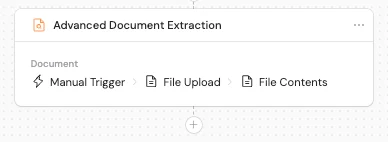
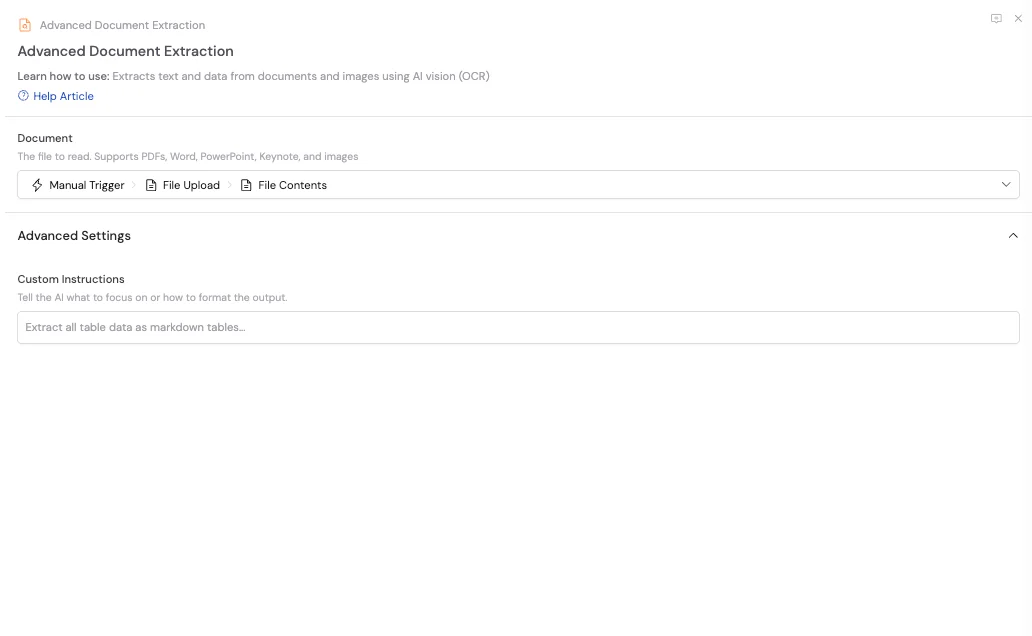 In the **Document** field, reference the file you want to read. Use **#** to [reference variables](/guides/prompt-engineering#workflow-prompts) from a previous step.
Common sources include:
* **Image uploads** from a [Manual trigger](/reference/triggers/manual) file input (images are not auto-parsed like PDFs and Word docs)
* **Email attachments** from an [Email trigger](/reference/triggers/email)
* **Downloaded files** from **Download File from URL** or integration download actions (Google Drive, SharePoint, Box, etc.)
* **Files inside a [Loop](/reference/actions/loop)** when processing multiple attachments or documents one at a time
The action outputs the extracted text as a single text variable. Reference it in subsequent actions to summarize, categorize, extract fields, or generate a response.
## Supported file types
| Type | Formats |
| ------------- | ------------------------------------------------------------------- |
| **Documents** | PDF, Word (`.doc`, `.docx`), PowerPoint (`.pptx`), Keynote (`.key`) |
| **Images** | PNG, JPEG, WEBP, GIF |
If the file type isn't supported, the action stops the Workflow with an error.
Convert the file to a supported format before passing it in.
Under **Advanced Settings**, add **Custom Instructions** to tell the AI what to focus on or how to format the output. For example:
* `Extract all table data as markdown tables`
* `Focus on the invoice number, date, and line items only`
* `Preserve headings and bullet lists from the original document`
Custom instructions are useful when you need a specific structure rather than a full verbatim transcription.
Pair **Advanced Document Extraction** with [Extract
Information](/reference/actions/extract-information) to turn unstructured
document text into structured fields you can send to CRM actions,
spreadsheets, or email steps.
## Related
* [Extract Information](/reference/actions/extract-information)
* [Get Knowledge Base File](/reference/actions/get-knowledge-base-file)
* [Email trigger](/reference/triggers/email)
* [Create files with Workflows](/guides/create-files)
In the **Document** field, reference the file you want to read. Use **#** to [reference variables](/guides/prompt-engineering#workflow-prompts) from a previous step.
Common sources include:
* **Image uploads** from a [Manual trigger](/reference/triggers/manual) file input (images are not auto-parsed like PDFs and Word docs)
* **Email attachments** from an [Email trigger](/reference/triggers/email)
* **Downloaded files** from **Download File from URL** or integration download actions (Google Drive, SharePoint, Box, etc.)
* **Files inside a [Loop](/reference/actions/loop)** when processing multiple attachments or documents one at a time
The action outputs the extracted text as a single text variable. Reference it in subsequent actions to summarize, categorize, extract fields, or generate a response.
## Supported file types
| Type | Formats |
| ------------- | ------------------------------------------------------------------- |
| **Documents** | PDF, Word (`.doc`, `.docx`), PowerPoint (`.pptx`), Keynote (`.key`) |
| **Images** | PNG, JPEG, WEBP, GIF |
If the file type isn't supported, the action stops the Workflow with an error.
Convert the file to a supported format before passing it in.
Under **Advanced Settings**, add **Custom Instructions** to tell the AI what to focus on or how to format the output. For example:
* `Extract all table data as markdown tables`
* `Focus on the invoice number, date, and line items only`
* `Preserve headings and bullet lists from the original document`
Custom instructions are useful when you need a specific structure rather than a full verbatim transcription.
Pair **Advanced Document Extraction** with [Extract
Information](/reference/actions/extract-information) to turn unstructured
document text into structured fields you can send to CRM actions,
spreadsheets, or email steps.
## Related
* [Extract Information](/reference/actions/extract-information)
* [Get Knowledge Base File](/reference/actions/get-knowledge-base-file)
* [Email trigger](/reference/triggers/email)
* [Create files with Workflows](/guides/create-files)